
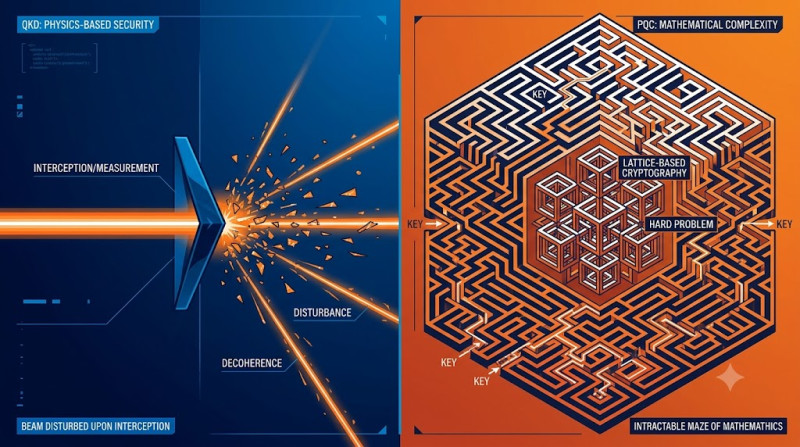
As organizations look for ways to protect long-lived data from Harvest Now, Decrypt Later (HNDL) tactics, they often encounter two distinct technologies: Post-Quantum Cryptography (PQC) and Quantum Key Distribution (QKD). While both aim to defend against quantum threats, they rely on entirely different principles. PQC uses advanced mathematics to secure software, while QKD relies on the fundamental laws of physics to secure hardware. Understanding the differences, strengths, and limitations of each is critical for any comprehensive security architecture.
Post-Quantum Cryptography (PQC): The Software Approach
As explored in previous articles, PQC relies on complex mathematical problems (like lattice dimensions) that are intractable for both classical and quantum computers.
-
Deployment: PQC is implemented purely in software or firmware. It uses existing internet infrastructure, fiber-optic networks, and routing hardware.
-
Scalability: High. It can be easily integrated into web browsers, operating systems, mobile phones, and cloud environments via standard software updates.
-
Cost: Low to moderate, primarily involving software development, testing, and migration labor.
Quantum Key Distribution (QKD): The Physics Approach
QKD takes a completely different path. It uses the principles of quantum mechanics—specifically, the No-Cloning Theorem—to securely share cryptographic keys. Photons are transmitted over a dedicated fiber-optic link or satellite connection. If an adversary attempts to intercept or observe the photons during transmission, the quantum state collapses, instantly alerting both parties to the intrusion.
[Sender] === (Quantum Channel: Photons) ===> [Receiver]
                 |
        (Adversary Tries to Intercept)
                 |
                 v
   [Quantum State Alters / Alert Raised]
-
Security Principle: QKD offers information-theoretic security. It does not matter how powerful an adversary's computer is; they cannot break the laws of physics.
-
Hardware Dependence: Extremely high. QKD requires specialized hardware, including single-photon generators, quantum detectors, and dedicated dark fiber lines.
Comparing the Two Against HNDL
When evaluating defense mechanisms against HNDL, both technologies offer valid protection but face distinct operational constraints.
| Feature | Post-Quantum Cryptography (PQC) | Quantum Key Distribution (QKD) |
| Primary Shield | Complex Mathematics | Quantum Physics |
| Infrastructure | Standard Internet / Software | Specialized Optical Hardware |
| Range Limits | Unlimited (Global Internet) | Limited (Typically < 100km without repeaters) |
| Authentication | Built-in via digital signatures | Requires a separate pre-shared key |
| Cost to Deploy | Scalable, software-driven | High infrastructure capex |
The Critical Limitations of QKD
While QKD provides absolute physical security for data in transit, it faces severe real-world challenges. It cannot easily scale across the global internet. Because photons attenuate over long distances inside fiber cables, QKD requires "trusted nodes" every few dozen kilometers to boost the signal. If an adversary compromises a trusted node classically, the security model breaks down entirely. Furthermore, QKD does not protect data at rest or solve the problem of digital signature authentication.
Conclusion
For the vast majority of enterprise and consumer applications looking to defeat HNDL, PQC is the clear choice due to its scalability and compatibility with modern network architectures. QKD remains a niche, highly secure solution suitable for short-range, high-value links between critical facilities, such as government buildings or financial data centers.