
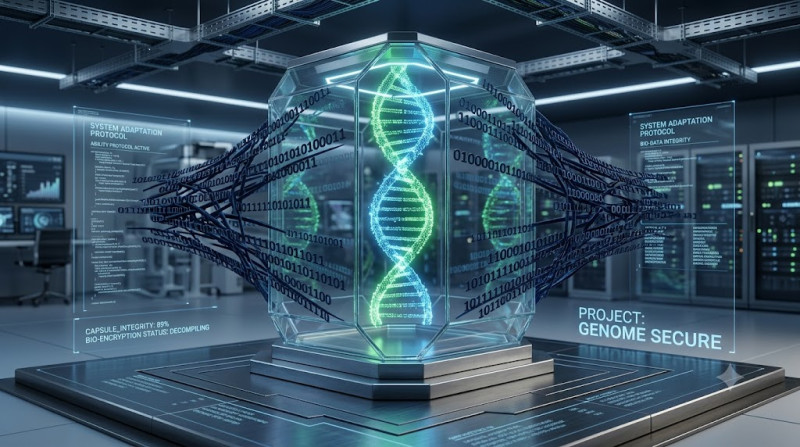
Of all the data classes currently targeted by "Harvest Now, Decrypt Later" (HNDL) strategies, none is more permanent, intimate, or structurally non-rotatable than human genomic data. While a compromised password can be reset, a breached credit card replaced, and a leaked corporate strategy bypassed through market pivot, your DNA sequence remains identical from the day you are born until the day you die. As health-tech companies, research laboratories, and national health services compile massive genetic databases, they are inadvertently building a high-value archive for long-term cyber espionage.
The Lifetime Value of a Genome
Genomic data possesses a literal lifetime shelf-life. In the context of the Mosca $X+Y>Z$ theorem, the variable $X$ (the required security duration) for genetic information spans 80 to 100 years. If an adversary harvests an encrypted file containing a comprehensive genomic sequence today, decrypting it 15 years from now yields information that is just as accurate, relevant, and actionable as it was the day it was sequenced.
Geopolitical Exploitation of Genetic Data
Why would a nation-state actor dedicate massive storage assets to harvesting encrypted medical and genetic data? The motivations go far beyond basic identity theft or medical insurance fraud:
-
Targeted Biological Countermeasures: Access to the genomic profiles of foreign populations or specific leadership cohorts allows for the theoretical development of highly targeted biological delivery mechanisms or personalized medical sabotage.
-
Blackmail and Political Coercion: A person's genome reveals genetic predispositions to debilitating mental or physical health conditions, hereditary diseases, and ancestral lineages. For political figures, diplomats, or intelligence officers, the future exposure of this data represents a permanent vulnerability to extortion.
-
Biometric Identity Forgery: As security architectures shift toward advanced biometric authentication (including DNA-based verification models in high-security environments), possession of the raw genomic blueprint allows adversaries to simulate identity markers with absolute precision.
The Fragility of Current Health Data Pipelines
The healthcare and biotechnology sectors are notorious for lagging behind in advanced cybersecurity practices. Massive volumes of genomic data are continuously transmitted between universities, private research centers, pharmaceutical companies, and cloud providers. These transfers often rely on standard commercial TLS networks or legacy file transfer protocols (FTP) protected by standard RSA or ECC parameters.
[DNA Sequencing Lab] === (Standard TLS Network) ===> [Cloud Research Database]
                               |
                   (Passive HNDL Interception)
                               |
                               v
                  [Adversary Storage Facility]
Because the immediate clinical utility of the data is the primary focus, the long-term quantum risk is frequently overlooked. This allows adversaries to passively harvest genetic databases at scale without triggering corporate or national security alarms.
Safeguarding the Biological Frontier
Protecting genomic data from HNDL requires the immediate enforcement of maximum-strength encryption standards. This includes wrapping genomic databases at rest in AES-256 (which remains quantum-safe) and mandating that any transmission of genetic sequences utilize hybrid post-quantum key exchanges.
Conclusion
Genomic data represents the ultimate long-term digital asset. Failing to protect it against HNDL today means outsourcing the biological privacy of entire generations to foreign adversaries, transforming modern medical progress into a long-term national security crisis.