
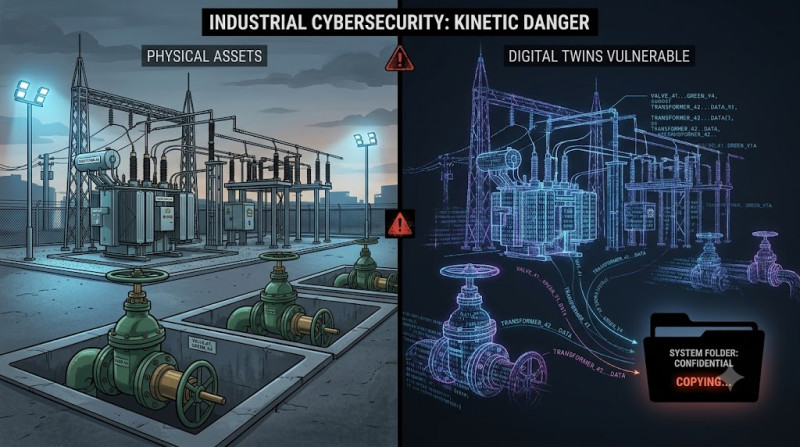
When discussing "Harvest Now, Decrypt Later" (HNDL), the immediate concern is often data privacy: stolen emails, financial records, or intellectual property. However, a far more dangerous dimension of this strategy lies within operational technology (OT) and Industrial Control Systems (ICS). These are the digital systems that manage the physical world—power grids, water treatment facilities, nuclear plants, and transportation networks. In the context of HNDL, adversaries are harvesting encrypted operational logs, firmware updates, and network topologies to prepare for catastrophic kinetic attacks in the future.
The Long Lifecycle of Operational Technology
Unlike corporate IT environments where hardware and software are refreshed every three to five years, industrial control environments operate on decades-long lifecycles. A turbine control system at a dam or an automated switching center on a railway network may be deployed with the expectation of running continuously for 20, 30, or 40 years.
Many of these legacy systems rely on hardcoded cryptographic keys or embedded firmware validation signatures that use older asymmetric standards like RSA-1024 or early Elliptic Curve variants. Because these systems are buried deep within industrial architectures, upgrading their cryptographic engines is an engineering nightmare that frequently requires complete, highly expensive facility shutdowns.
What is Being Harvested in the OT Space?
Adversaries do not harvest ICS data to read corporate emails; they are looking for the blueprints of physical destruction.
-
Network Topologies and SCADA Maps: Encrypted configuration files and network maps detail exactly how an industrial facility is wired. Decrypting this data reveals the precise relationships between programmable logic controllers (PLCs) and physical valves or breakers.
-
Firmware Signing Keys: Private keys used to sign official firmware updates for industrial equipment are highly targeted. If an adversary harvests these signing keys, a future quantum computer can extract the private key. This allows the actor to author malicious firmware that looks completely legitimate to the system, enabling them to permanently disable or destroy physical machinery.
-
Operational Baselines: Long-term encrypted historian logs contain the precise normal operating boundaries (temperatures, pressures, voltages) of a plant. Access to this historical data allows an attacker to design a cyber-weapon that forces a system into catastrophic failure while spoofing normal telemetry to human operators (similar to the Stuxnet architecture).
[ICS Network Session] ---> Contains: SCADA Maps / Firmware Signatures / Operational Logs
                                    |
                         (Passive HNDL Storage)
                                    |
                                    v
[Future Quantum Decryption] -> Extracts Firmware Signing Keys & Facility Blueprints
                                    |
                                    v
                        [Targeted Kinetic Sabotage]
The Kinetic Consequence
The ultimate goal of HNDL in the industrial sector is strategic deterrence or pre-emptive sabotage. A nation-state actor can harvest the encrypted control files of an adversary's electrical grid today, wait for the quantum capability to mature, and decrypt the files on the eve of a geopolitical conflict. This grants them the ability to instantly disable critical infrastructure without firing a single physical missile.
Conclusion
HNDL in industrial control environments transforms a digital security flaw into a threat to physical safety. Because industrial infrastructure outlives classical cryptography, securing these networks with immediate post-quantum perimeters is a matter of basic societal survival.