
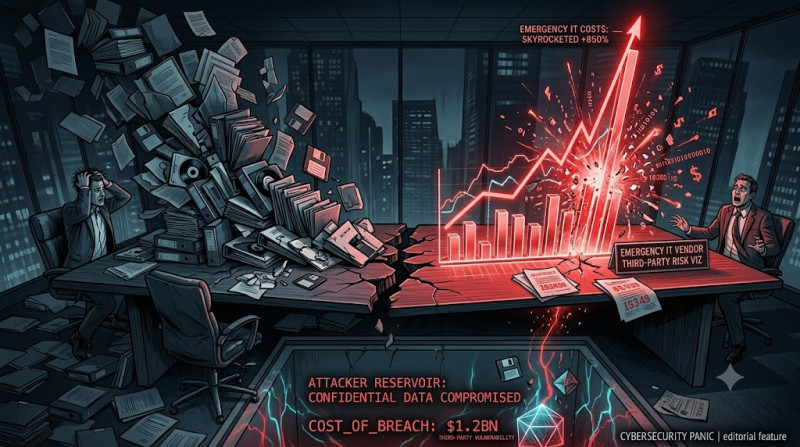
As the cybersecurity community emphasizes the reality of Harvest Now, Decrypt Later (HNDL), corporate leadership teams frequently push back on the timeline. Upgrading the global cryptographic infrastructure requires significant capital, labor, and operational testing. In the face of competing short-term business priorities, many CFOs and boards ask a simple question: "Can we afford to wait a few more years before we fund this transition?" The cold mathematical and operational reality is that the cost of delaying post-quantum cryptography (PQC) increases exponentially with each passing year.
The Accumulating Inventory of Defenseless Data
The most immediate cost of delaying PQC migration is the continuous accumulation of harvested data. Every day an enterprise operates on legacy asymmetric encryption standards (like RSA or ECC), it transmits thousands of gigabytes of long-lived data over public networks.
An adversary harvesting that traffic today adds it to their cold storage archives. Even if the company upgrades to PQC next year, the data transmitted this year is already lost; it is sitting in an enemy repository, waiting to be read. The cost of delay is therefore measured by the total market value of all intellectual property, data assets, and strategic secrets exposed during the period of procrastination.
The Compression of the Migration Timeline
Refer back to the Mosca theorem: $X + Y > Z$. If an organization delays funding its migration, the variable $Y$ (the time required to execute the transition) does not shrink. In fact, as enterprise architectures grow more complex, integrate more cloud services, and deploy more IoT endpoints, the time required to inventory and replace cryptography actually increases.
[Scenario A: Early Migration]
Time Available: 10 Years | Migration Window: 5 Years (Planned, Low Cost)

[Scenario B: Delayed Migration]
Time Available: 4 Years  | Migration Window: 5 Years (Forced Compression -> High Cost & Systems Failure)
By postponing the start date, the enterprise forces itself into a compressed migration window as the quantum deadline ($Z$) draws closer. A compressed migration is a financial catastrophe. It requires hiring specialized, high-cost emergency consultants, forces hasty deployments that lead to massive network downtime, and drastically increases the risk of architectural failure.
The Vendor Lock-In and Retrofit Premium
Upgrading software and hardware during a routine refresh cycle is highly cost-effective. If an enterprise mandates that all new software acquisitions and hardware updates over the next five years must support native post-quantum algorithms, the cost of migration is naturally absorbed into standard operational expenditures.
However, if an enterprise waits until the eleventh hour, it will be forced to retroactively patch and rewrite legacy applications that are no longer supported by their original developers. This "retrofit premium" can swell IT migration budgets by a factor of ten compared to an orderly, proactive transition strategy.
The Ultimate Cost: Market Elimination
The final cost of delaying PQC is the potential destruction of the enterprise itself. For companies whose valuation is tied entirely to proprietary technology, clinical data, or trade secrets, the retroactive exposure of that data via HNDL means an absolute loss of market differentiation, immediate loss of shareholder confidence, and potential regulatory fines that can drive a business into bankruptcy.
Conclusion
Procrastination in the face of the quantum threat is a massive, unhedged financial gamble. The cost of deploying post-quantum security today is an investment in operational resilience; the cost of delaying it is an expensive tax that many corporations will not survive to pay.