
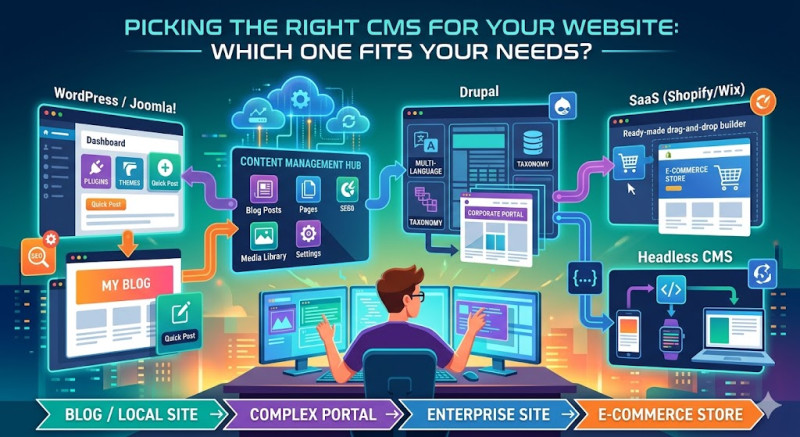
Picking the Right CMS for Your Website: Which One Actually Fits Your Needs?
Let’s be honest: building a website today is a whole different ball game than it was a decade ago. Gone are the days when you needed to know how to code just to fix a typo or change an image. Thanks to Content Management Systems (CMS), managing a website is now as easy as typing a Word document.
But here is the catch—if you start looking for the "best" CMS, you’ll quickly find yourself staring at an overwhelming sea of options. The truth is, there isn't one single perfect platform. There’s only the platform that’s perfect for you.
Let’s break down the heavy hitters so you can figure out which one actually makes sense for your project.
1. WordPress: The Undisputed King of the Web
Fun fact: WordPress powers over 40% of the entire internet. That’s not a typo. It started as a humble blogging tool, but it evolved into an absolute powerhouse because it’s incredibly flexible.
-
Best for: Bloggers, small to medium businesses, and—thanks to the WooCommerce plugin—anyone wanting to launch an online shop without losing their mind.
-
The Good: The ecosystem is massive. There are thousands of themes and plugins (both free and paid) to make your site do whatever you want. Plus, because it's so popular, if you hit a snag, someone on Google has already solved it. It’s also fantastic for SEO right out of the box.
-
The Bad: It requires maintenance. If you overload it with too many plugins, your site will slow down to a crawl. Also, because it's so popular, it's a frequent target for hackers, so you have to keep everything updated.
2. Joomla!: The Sweet Spot for Organized Chaos
Think of Joomla! as the middle child between the simplicity of WordPress and the complexity of Drupal. It’s designed for websites that need a bit more structural muscle right from the start.
-
Best for: Membership sites, news portals, and corporate websites with a lot of moving parts.
-
The Good: It has a brilliant built-in user management system (great if you have multiple editors with different permissions) and handles multi-language sites beautifully without needing extra plugins.
-
The Bad: It’s not as beginner-friendly as WordPress. There’s a bit of a learning curve, and the marketplace for ready-made themes is much smaller.
3. Drupal: The Heavyweight Champion
If your website was a car, Drupal would be a semi-truck or a tank. It’s not really a simple CMS; it’s a powerful framework built for enterprise-level projects.
-
Best for: Large corporations, universities, government sites, and massive hubs handling serious amounts of data and traffic.
-
The Good: Unmatched security, incredible performance under heavy traffic loads, and limitless customization. If you can dream it, you can build it in Drupal.
-
The Bad: Unless you are a developer (or have a budget to hire one), stay away. The learning curve is steep, and setting it up takes real technical know-how.
The Modern Alternatives: SaaS and Headless CMS
The web moves fast, and over the last few years, two other major players have taken over the conversation:
-
SaaS Builders (like Shopify or Squarespace): This is the ultimate "hands-off" approach. You pay a monthly fee, and they handle the hosting, security, and tech stuff. You just drag and drop your content. It’s perfect if you want a beautiful site up and running by tonight.
-
Headless CMS (like Strapi or Contentful): A favorite among modern developers. It separates the backend (where you write content) from the frontend (the design). This means you can write an article once and push it simultaneously to your website, mobile app, and even a smartwatch.
Quick Cheat Sheet: Which One Wins?
To make your life easier, here’s a quick look at what to choose based on what you’re actually doing:
| If your project is... | ...Go with: | Why? |
| A blog, portfolio, or local business site | WordPress | Fast setup, easy to use, budget-friendly. |
| A portal with complex user roles | Joomla! | Great built-in content and user control. |
| An enterprise site with massive data | Drupal | Rock-solid security and pure horsepower. |
| An e-commerce store with zero tech stress | Shopify | Smooth, reliable, and handles the hosting for you. |
The Bottom Line
Don't choose a CMS based on what's "trendy." Choose it based on your goals and your technical comfort level. The best CMS is the one that lets you publish your content smoothly without making you want to throw your laptop out the window!