
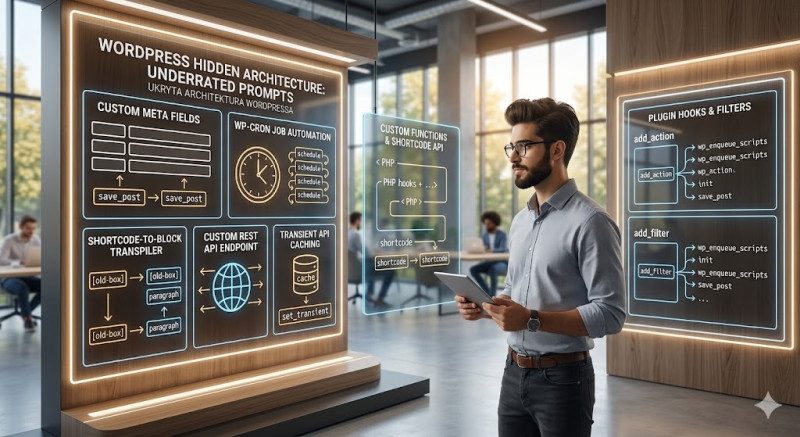
While most creators use AI to generate simple blog posts or generic CSS tweaks, WordPress contains deep, complex layers that remain completely untapped by the average user. Deep within the core architecture lie advanced functionalities—like custom metadata tracking, database management, and automated plugin hooks—that can be fully controlled with the right structural prompts.
Here are 5 highly advanced, underrated prompts that unlock the true developer-level power of WordPress.
1. The Custom Meta Box and Field Architecture
Relying on heavy plugins like Advanced Custom Fields (ACF) just to add a few custom text fields to your post editor slows down your dashboard. WordPress has a native API for this, which is rarely used via AI.
-
The Prompt:
"Act as a Principal WordPress Developer. Write a clean, object-oriented PHP script to natively register a custom Meta Box for the 'post' post type. Include fields for [Insert Fields, e.g., 'Review Score' and 'Sponsor URL']. The script must use standard WordPress hooks (add_meta_boxesandsave_post), include strict nonces for security, and implement data sanitization and escaping (sanitize_text_field,esc_url)." -
Why it's powerful: It allows you to build custom CMS features using 100% native WordPress code, keeping your site fast and independent of third-party plugin licenses.
2. The Custom REST API Endpoint Provisioner
Modern web design relies heavily on headless architectures and decoupled front-ends. This underutilized prompt creates a secure gateway for external applications to fetch data from your site.
-
The Prompt:
"Create a secure custom WordPress REST API endpoint under the namespace 'custom/v1' called '/latest-reviews/'. The callback function should fetch the 3 latest posts with a custom meta key of 'is_featured'. Implement permission callbacks (permission_callback) ensuring only authenticated requests can access it, and return the data using theWP_REST_Responseclass." -
Why it's powerful: It bypasses standard theme limitations, letting you feed your WordPress data safely to external mobile apps, widgets, or web portals.
3. The Cron Job Automation Script (WP-Cron)
Instead of manually running database cleanups or checking external APIs, you can program WordPress to run background tasks silently during off-peak hours.
-
The Prompt:
"Write a PHP snippet to schedule a recurring custom WP-Cron job named 'hourly_inventory_sync' that runs every hour. Include a custom interval registration if needed, hook a placeholder logging function into the action, and use a safety check withwp_next_scheduledto prevent duplicate event registration."
4. The Shortcode-to-Block Transpiler
If you are migrating an old WordPress site to the modern block editor (Gutenberg), you likely have hundreds of obsolete, ugly shortcodes ([old-gallery id="123"]) scattered throughout your database.
-
The Prompt:
"Act as a Database Engineer specializing in WordPress. Write a safe SQL query and a supporting PHP wrapper script that parses thewp_poststable to find all instances of the shortcode[old-box text='...']and replaces them with a native Gutenberg paragraph block containing the same text. Include a backup safety warning and a dry-run log mechanism." -
Why it's powerful: It solves a massive legacy migration headache in seconds, instantly cleaning up years of technical debt without manual editing.
5. The Transient API Caching Engine
When querying heavy external APIs (like weather updates, Instagram feeds, or stock prices), fetching data on every page load can crash your site.
-
The Prompt:
"Write a WordPress function that fetches data from an external API URL usingwp_remote_get. Implement the WordPress Transient API to cache the JSON response for exactly 4 hours (set_transient). If the transient exists, serve the cached data; if it doesn't, fetch new data, handle potential API errors gracefully, and update the cache."
The Professional Rule:
When using these advanced prompts, always append your specific WordPress version and environment details (e.g., PHP 8.2, Apache server) to ensure the generated code uses up-to-date, secure programming paradigms.