
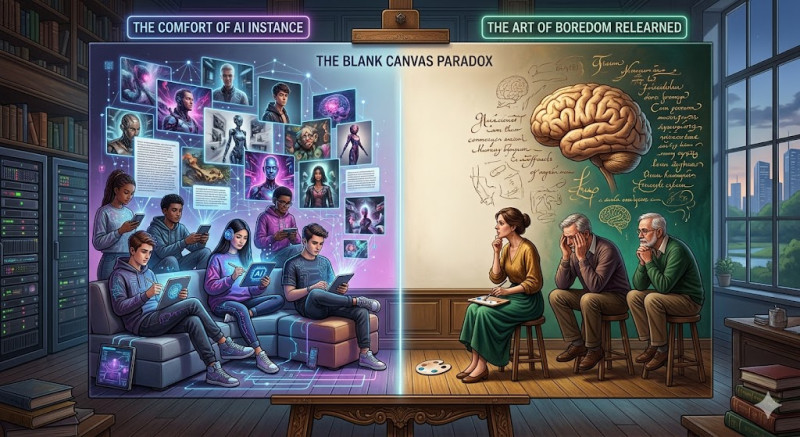
We are living in the era of the absolute eradication of friction. If you want a cyberpunk illustration of a neon-lit Warsaw, a melancholic lo-fi track in the style of Chopin, or a 500-word essay on post-humanism, you can have it in seven seconds. Generative AI has transformed the creative process from a grueling marathon into an instantaneous vending machine.
Yet, this infinite abundance has triggered a quiet crisis: The Blank Canvas Paradox. When the canvas fills itself automatically, we lose the very thing that drives genuine human innovation—boredom.
The Death of the Creative Incubator
Historically, boredom was the painful, restless engine of creativity. It was the empty space that forced the mind to wander, connect disparate ideas, and build something out of nothing. When a writer stared at a blank page, or an artist sat before a white canvas, the discomfort of that emptiness pushed them to dig deep into their own subconscious.
AI has eliminated that discomfort. Today, the moment a hint of boredom creeps in, we don't daydream; we prompt. We ask Midjourney or ChatGPT to fill the void.
The paradox lies here: By instantly escaping the blank canvas, we bypass the incubation period required for true originality. Instead of producing art from the depths of personal emotion or unique human error, we rely on the statistical averages of a machine's training data. We are substituting profound inspiration with hyper-efficient curation.
The Trap of "Instant Gratification Burnout"
When everything can be generated effortlessly, a strange psychological shift occurs: novelty loses its value. If a teenager can generate a Hollywood-grade cinematic trailer on their phone in a few minutes, the magic of cinema begins to fade.
This constant stream of instant, frictionless creation leads to a specific type of cognitive fatigue. The AI generation is flooded with dopamine from seeing their ideas come to life instantly, but they are starved of the satisfaction that comes from labor. Without the struggle of drafting, erasing, failing, and trying again, the final product feels hollow. We are creating more than ever, but we are feeling less connected to what we produce.
Why the Future Belongs to the "Bored"
As AI tools become ubiquitous, the competitive advantage will no longer be knowing how to use them, but knowing when to turn them off. The most valuable minds of the AI generation will be those who can tolerate the silence of a blank canvas.
Relearning boredom is not about being counter-productive; it is a tactical necessity. It is about allowing the brain to enter its default mode network—the neurological state where random, non-linear, and deeply empathetic human insights are formed.
To survive the algorithmic wave, the next generation must cultivate "intentional emptiness." This means:
-
Staring at the wall: Letting the mind wander without a digital pacifier.
-
Embracing frustration: Recognizing that the struggle to articulate an idea is where personal style is born.
-
Friction by design: Disconnecting from generative tools during the initial stages of a project to find a truly authentic voice.
The blank canvas was never an enemy to be conquered by an algorithm; it was an invitation to discover who we are. If we let AI fill every silence and color every blank space, we might find ourselves in a world with infinite art, but no artists left to create it.