
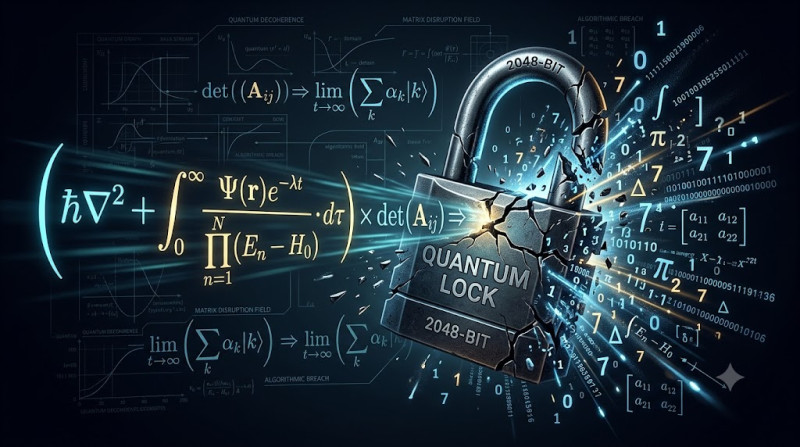
To truly understand the urgency behind the Harvest Now, Decrypt Later (HNDL) strategy, one must look closely at the underlying mathematics. The entire foundation of modern internet security—from secure e-commerce to protected government communications—rests on a handful of mathematical problems that are easy to perform in one direction but incredibly difficult to reverse. In 1994, a mathematician named Peter Shor published an algorithm that fundamentally challenged this foundation. Shor’s Algorithm proved that a quantum computer could solve these "hard" problems efficiently, signaling the eventual collapse of asymmetric cryptography.
The Foundation: Asymmetric Cryptography Today
Before examining Shor’s Algorithm, we must review why current systems work. Asymmetric encryption uses a pair of keys: a public key for encryption and a private key for decryption.
-
RSA: Relies on the difficulty of prime factorization. It is easy to multiply two large prime numbers together, but extremely difficult to find the prime factors of a massive composite number.
-
Diffie-Hellman & ECC: Rely on the discrete logarithm problem.
Classical computers must attempt to solve these problems through brute force or advanced sieving methods, which require exponential time relative to the key length. As a result, our data remains secure because the universe itself might end before a classical supercomputer cracks the code.
Enter Shor’s Algorithm
Shor’s Algorithm is a quantum algorithm capable of finding the prime factors of an integer in polynomial time. Instead of checking every possible factor one by one, a quantum computer exploits quantum superposition and interference to find the period of a specific mathematical function related to the problem.
-
Superposition: Allows the quantum computer to hold multiple states simultaneously, effectively analyzing all potential solutions at once.
-
Quantum Fourier Transform (QFT): This is the core engine of Shor’s Algorithm. The QFT isolates the correct periodic pattern among the superposed states, amplifying the correct answer while canceling out the incorrect ones through destructive interference.
Because the algorithm runs in polynomial time ($O((\log N)^3)$), increasing the key size from RSA-2048 to RSA-4096 only provides a marginal increase in security against a quantum attack, whereas it significantly slows down classical systems. It is a battle that asymmetric cryptography cannot win.
The Impact on the HNDL Timeline
Adversaries utilizing the HNDL strategy are counting down to the year when a Cryptanalytically Relevant Quantum Computer (CRQC) becomes reality. While current quantum computers (Noisy Intermediate-Scale Quantum or NISQ devices) suffer from high error rates and limited physical qubits, intensive research is being poured into quantum error correction.
Experts estimate that breaking RSA-2048 requires a quantum computer with a few thousand stable, logical qubits, which translates to several million noisy physical qubits. The consensus within the cybersecurity community suggests this threshold could be reached sometime in the 2030s. For an adversary storing intercepted data today, a ten-year waiting period is a small price to pay for total access to legacy secrets.
Summary
Shor’s Algorithm is the mathematical engine driving the Harvest Now, Decrypt Later phenomenon. It transforms what was once considered an absolute mathematical wall into a temporary hurdle. Organizations cannot afford to wait until the first CRQC is announced; by then, every byte of data transmitted over standard networks prior to that date will be laid bare.