
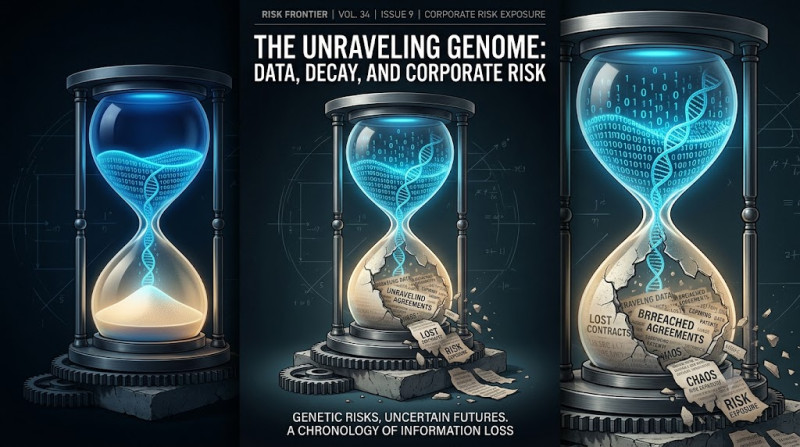
A common fallacy among corporate executives and risk officers is the belief that quantum computing is a "future risk" that can be managed tomorrow. They view cybersecurity through a static lens: if our encryption holds today, our data is safe today. However, the Harvest Now, Decrypt Later (HNDL) strategy introduces a temporal dimension to cybersecurity risk. To properly evaluate the threat of HNDL, organizations must implement a rigorous framework to assess the "shelf-life" of their data.
The Theorem of Quantum Risk
Security expert Michele Mosca formulated a simple yet powerful equation to determine when an organization must migrate to quantum-resistant architecture:
-
X (Data Shelf-Life): How many years must your data remain secure and confidential?
-
Y (Migration Time): How many years will it take your organization to upgrade its infrastructure to Post-Quantum Cryptography (PQC)?
-
Z (Quantum Timeline): How many years until a cryptanalytically relevant quantum computer is developed?
If the combined time required to protect your data and upgrade your systems exceeds the time it takes for adversaries to build a quantum computer, your data is already vulnerable to HNDL.
Categorizing Data by Longevity
Not all data is created equal. Some information loses its value within minutes, while other datasets remain sensitive for generations.
| Data Type | Typical Shelf-Life | HNDL Risk Level |
| Financial Transactions | Days to Months | Low (Value decays quickly) |
| Corporate Mergers & Acquisitions | 1 to 3 Years | Medium (Short-term market impact) |
| Intellectual Property / Trade Secrets | 10 to 30+ Years | Critical (Directly impacts market survival) |
| Biometric & Healthcare Data | Lifetime (50+ Years) | Critical (Permanent identity markers) |
| State & Military Secrets | 20 to 50+ Years | Extreme (National security implications) |
The Corporate Blindspots
Many enterprises mistakenly assume that their standard compliance frameworks protect them from HNDL. Compliance standards like GDPR, HIPAA, or PCI-DSS require data to be encrypted "at rest" and "in transit" using approved algorithms like AES and RSA. However, these frameworks do not account for the future decryption of intercepted data.
For instance, a pharmaceutical company transmitting proprietary clinical trial data for a groundbreaking drug via standard TLS 1.3 (utilizing ECC or RSA) satisfies current regulatory requirements. Yet, if an adversary intercepts this stream, they can decrypt it in a decade, duplicate the formula, and launch a generic competitor just as the original drug enters its most profitable market phase.
Actionable Steps for Risk Assessment
To counter this, organizations must audit their data repositories and data flows through an HNDL lens. This involves mapping out exactly where long-lived data is transmitted across public or third-party networks, identifying the cryptographic primitives protecting that data, and calculating the exact value of $X$ for every critical asset class.
Conclusion
The danger of HNDL is not defined by when the quantum computer arrives, but by how long your data needs to remain secret. If your data’s shelf-life extends past the next decade, traditional encryption is no longer a safe haven—it is merely a time-delayed exposure.