
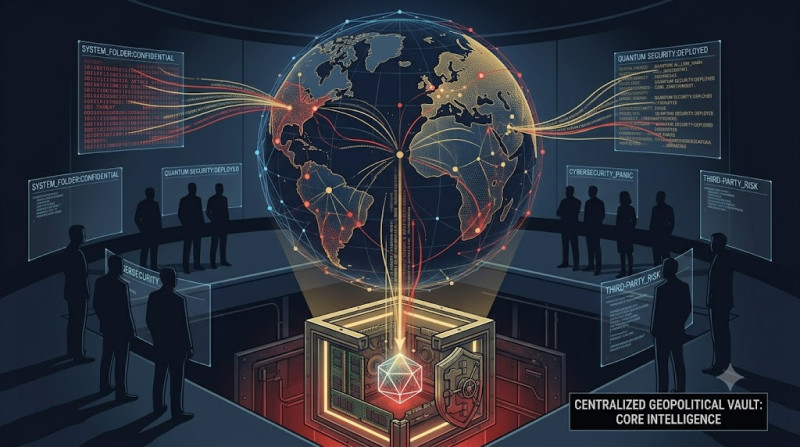
The strategy of Harvest Now, Decrypt Later (HNDL) is not typically driven by lone-wolf hackers or casual ransomware groups. The infrastructure required to intercept, catalog, and store petabytes of encrypted data requires massive financial backing, advanced engineering, and long-term strategic patience. Consequently, HNDL is primarily a tool of nation-state actors. We are currently living in a silent Cyber Cold War, where global superpowers are hoarding encrypted data to secure geopolitical, military, and economic dominance in the decades to come.
The Actors and Infrastructure
Major nation-states have established vast signal intelligence (SIGINT) capabilities designed specifically for bulk data collection. These entities monitor global internet traffic at strategic chokepoints, such as undersea fiber-optic cable landing stations, satellite communication downlinks, and major internet exchange points (IXPs).
By implementing passive optical splitters, these intelligence agencies can copy entire streams of international data traffic without degrading network performance or alerting network operators. The copied data is then funneled into classified storage facilities—often spanning multiple football fields in size—powered by dedicated energy grids designed to sustain continuous data ingestion.
Strategic Objectives: What Are They Looking For?
Nation-states do not harvest data blindly; they target specific sectors that will yield long-term strategic advantages.
-
Geopolitical Intelligence: Decrypting historical diplomatic communications allows an adversary to understand the negotiation tactics, internal vulnerabilities, and psychological profiles of foreign leaders. Even decade-old political secrets can be used as leverage or blackmail.
-
Military Technology: Blueprints for advanced fighter jets, submarine propulsion systems, and missile guidance arrays take decades to develop. Intercepting encrypted defense contractor communications today allows an adversary to leapfrog stages of R&D or develop targeted countermeasures before the weapon systems are even deployed.
-
Economic Espionage: State-sponsored actors target core industrial sectors such as aerospace, biotechnology, advanced materials, and semiconductor manufacturing. Access to these proprietary designs ensures long-term industrial dominance.
The Asymmetric Nature of the Threat
HNDL represents an asymmetric threat because the cost of offense is radically decoupled from the cost of defense. For the harvester, the primary costs are storage media and electricity. For the victim, the cost includes the total loss of strategic positioning, compromised intelligence networks, and eroded economic competitiveness.
Furthermore, Western democracies, which rely heavily on open, interconnected economies and transparent corporate structures, present a much larger attack surface than closed, authoritarian regimes. This digital openness makes Western enterprises and government agencies premier targets for bulk data harvesting operations.
Implications for International Relations
As quantum computing capabilities near maturation, the possession of harvested data will alter the balance of power. The nation that achieves a cryptanalytically relevant quantum computer first will possess an immediate, profound information advantage, effectively rendering the communications of its rivals transparent.
Conclusion
HNDL is an instrument of statecraft. Understanding that your encrypted corporate or governmental data is sitting in a foreign data center, waiting for a quantum key, changes how we must approach national defense and corporate security. It elevates post-quantum migration from a routine IT upgrade to a matter of sovereign survival.