
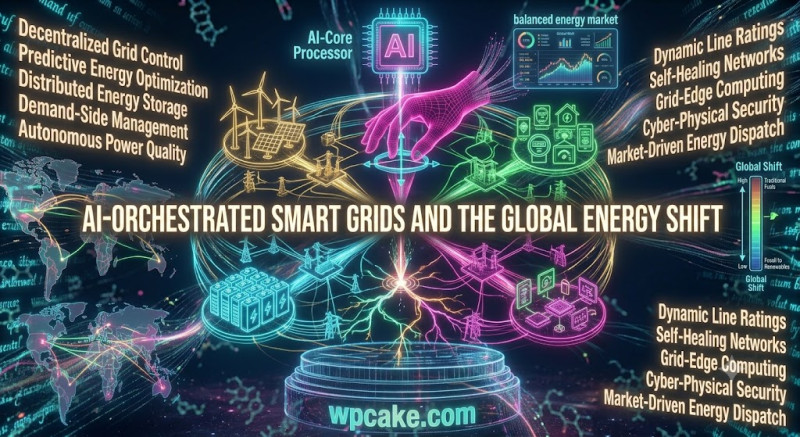
The global transition toward renewable energy has long faced a persistent challenge: the inherent volatility of wind, solar, and tidal power sources. Because weather conditions fluctuate unpredictably, traditional power grids have struggled to balance supply and demand without relying on fossil-fuel power plants as backups. In May 2026, this stabilization challenge has been elegantly resolved through the worldwide deployment of AI-Orchestrated Hyper-Grids. These centralized deep-reinforcement learning networks manage entire national energy grids, forecasting generation capabilities and redistributing power dynamically with millisecond precision.
These sophisticated AI systems process astronomical amounts of real-time data, including localized meteorological satellite feeds, historic consumption patterns, industrial operational schedules, and even real-time charging metrics from millions of electric vehicles connected to the grid. By leveraging predictive transformers, the AI can anticipate a localized drop in solar production hours before cloud cover arrives, automatically triggering adaptive adjustments in regional battery storage systems and shifting surplus energy from wind farms hundreds of miles away. This eliminates waste and ensures absolute stability across the network.
Furthermore, these smart grids have enabled the growth of localized peer-to-peer energy trading markets. Homeowners with residential solar panels and private battery walls can allow the grid's AI to automatically sell their surplus electricity back to the network during peak hours, creating a highly efficient, decentralized energy marketplace. Commercial buildings are utilizing identical localized micro-models to optimize their HVAC and lighting systems dynamically, resulting in an immediate reduction in global corporate energy costs. Through this seamless fusion of machine intelligence and clean technology, May 2026 stands as a defining turning point where the global power grid becomes truly green, reliable, and intelligent.