
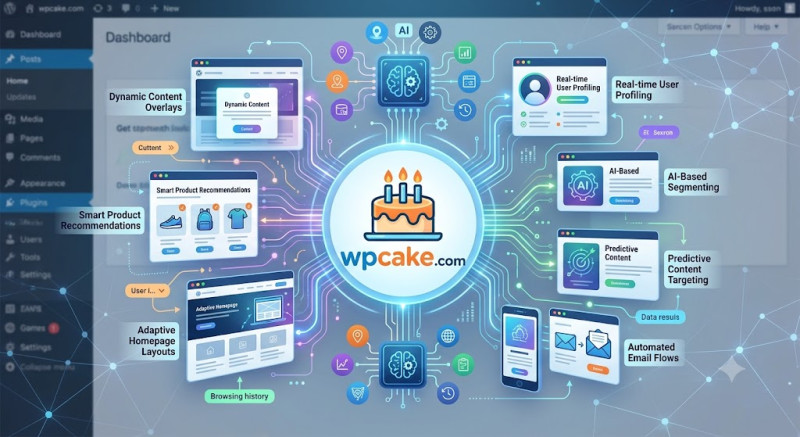
The landscape of WordPress development has undergone a monumental shift in May 2026, driven primarily by the integration of advanced, autonomous AI personalization engines. For years, WordPress site owners relied on rigid, rule-based plugins to show specific content to different user segments. Today, new AI solutions operate on real-time behavioral analysis, transforming static websites into fluid, hyper-personalized digital experiences.
These next-generation WordPress plugins utilize localized, lightweight LLMs (Large Language Models) that run efficiently without slowing down page load times. When a visitor lands on a WordPress site, the AI instantly analyzes their referral source, past browsing history, device metrics, and even real-time mouse movement patterns. Within milliseconds, the layout, headline, and product recommendations adapt to match the user's explicit intent. For instance, an e-commerce store built on WooCommerce can now display entirely different homepage hero sections to a returning tech enthusiast versus a first-time shopper looking for a gift.
Furthermore, the integration process has been simplified to a single click. Developers no longer need to manually tag content or set complex conditional logic. The AI autonomously categorizes the entire WordPress media library, post archive, and product catalog using semantic vectors. It understands the context of the content, allowing it to serve highly relevant internal links and call-to-actions that feel natural rather than forced.
As we move forward in 2026, the metrics speak for themselves. Early adopters of these autonomous personalization suites report up to a 45% increase in user engagement and a significant drop in bounce rates. WordPress is no longer just a Content Management System; it has evolved into an Intelligent Experience Platform, setting a new benchmark for how businesses interact with audiences online.