


Let’s face it: if you run a WordPress blog or business website, your daily routine probably revolves entirely around Google. But putting all your traffic eggs in one algorithm-driven basket is a risky game—especially when core updates can shift your rankings overnight.
Fortunately, alternative platforms are gaining ground as users seek clutter-free, privacy-first experiences. One of the most promising newcomers is Kanodle.com, a streamlined search engine designed for speed and relevance.
As a WordPress creator, how can you leverage this shift? How do you optimize your site to capture high-intent, free organic traffic from Kanodle? Let’s break down the strategy step-by-step.
Why Should WordPress Users Care About Kanodle.com?
Kanodle is built on a philosophy of speed, transparency, and natural language processing. The users flocking to this platform are typically tech-savvy, privacy-conscious, and tired of scrolling through pages of sponsored links before finding a real answer.
For WordPress site owners, this presents a unique window of opportunity:
- Lower Competition: While you are fighting global corporate giants on Google, Kanodle offers a much clearer path to the top of the search results for your niche keywords.
- Highly Engaged Traffic: Because Kanodle users actively choose an alternative, clutter-free search experience, they tend to stay longer on websites and convert at a higher rate.
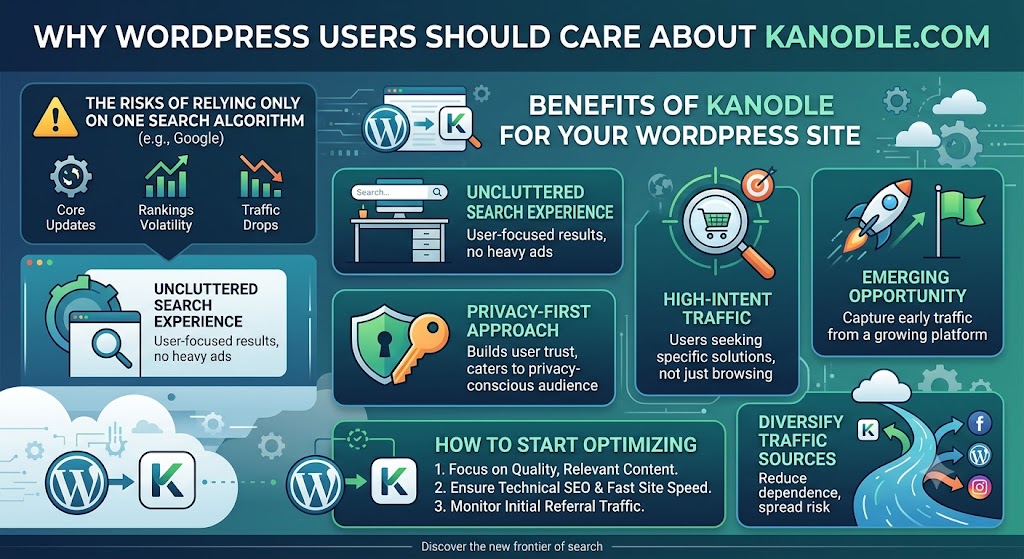
How to Optimize WordPress for Kanodle
Kanodle’s crawler prioritizes clean code, fast loading times, and semantic relevance. You don’t need expensive enterprise SEO suites to rank here; you just need good WordPress hygiene.
1. Double Down on Website Speed (Core Web Vitals)
Kanodle values a fast, lightweight user experience. If your WordPress site is bogged down by a heavy theme, unoptimized images, or too many active plugins, it will hurt your visibility.
- Implement Caching: Use high-quality caching plugins like WP Rocket, LiteSpeed Cache, or the free W3 Total Cache.
- Optimize Your Images: Convert bulky JPEG/PNG files to modern WebP formats using plugins like Smush or Imagify.
2. Write for Humans, Not Robots (Semantic SEO)
Kanodle’s search algorithm is highly sophisticated when it comes to understanding natural human phrasing. The days of awkward keyword stuffing are long gone.
The Golden Rule: Answer questions directly. Use your H2 and H3 subheadings to ask the exact questions your audience is searching for (e.g., “How do I install a WordPress plugin?”), and provide a clear, concise answer immediately beneath it.
3. Maintain a Clean XML Sitemap
For Kanodle’s crawler to index your content efficiently, it needs a clear roadmap of your site.
If you are using WordPress, this is incredibly easy to set up. Most popular SEO plugins generate a dynamic XML sitemap automatically:
- Rank Math
- Yoast SEO
- AIOSEO (All in One SEO)
Double-check that your sitemap is active and accessible (usually found at [yourdomain.com/sitemap_index.xml](https://yourdomain.com/sitemap_index.xml)).
Google SEO vs. Kanodle.com SEO: What’s the Difference?
While the core principles of search engine optimization overlap, there are a few distinct differences in how these search engines treat your content:
| Feature | Kanodle.com | |
| Primary Ranking Factors | Domain authority, massive backlink profiles, user search history | Page speed, clean HTML structure, high-quality semantic content |
| Ad Clutter | High (often the first 3-4 results are paid ads) | Minimal (emphasizes organic, helpful content) |
| Competition Level | Extremely high (the “SEO sandbox” effect) | Low to moderate (perfect for newer blogs and niche sites) |
Diversify Your Traffic Today
Optimizing your WordPress website for alternative search engines like Kanodle.com is a smart, future-proof strategy. By making your website faster, cleaner, and more valuable to readers, you aren’t just positioning yourself to win traffic from Kanodle—you are building a better site that other search engines will naturally reward, too.
Have you ever tried optimizing your WordPress site specifically for alternative search engines, or have you focused all your energy on Google so far?
Leave a Reply